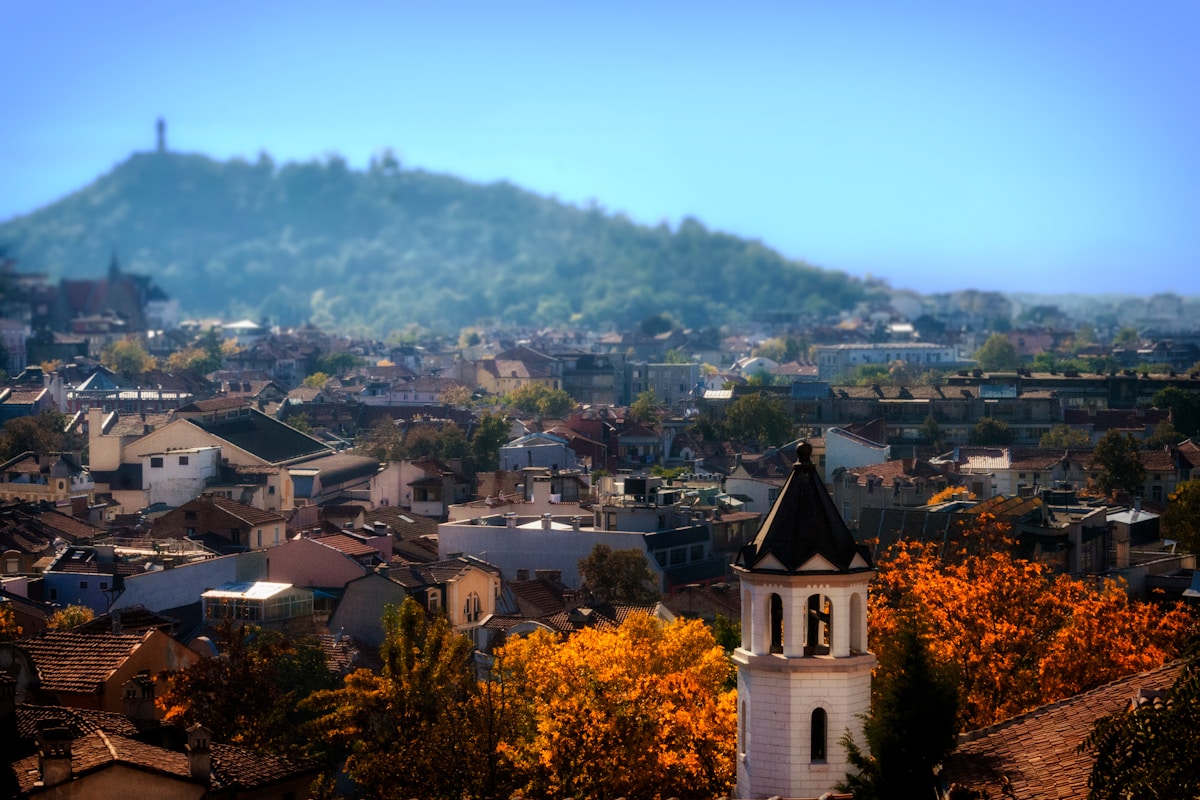
Plovdiv Travel Guide: Bulgaria's Most Beautiful City
Plovdiv travel guide: the Old Town hills, Roman Amphitheatre, Kapana Creative District, Dzhumaya Mosque, and how to get there from Sofia, perfect for hik.
Guides for Plovdiv Travel Guide
Plovdiv is the city that consistently surprises visitors who arrive expecting a secondary Bulgarian destination. Bulgaria’s second-largest city sits on the Maritsa River in central Bulgaria and has a historic core that outlasts most comparable old towns in the region: a Roman amphitheatre embedded in the modern city centre, a 19th-century National Revival neighbourhood of painted merchant houses on three hills, and a former artisan quarter repurposed as a creative district without losing its street-level character.
It was named European Capital of Culture in 2019 - an investment that produced infrastructure improvements, new venues, and a sharpened sense of what the city could offer. The benefits have outlasted the year itself.
Getting to Plovdiv
From Sofia: The most travelled route. Buses depart from Sofia’s main bus station (Central Bus Station, Centralena Avtogara) and the journey takes approximately 2 hours. Tickets cost around €5 each way. Multiple companies operate the route throughout the day; the first buses run from around 06:30 and the last from around 21:00. Trains are available on the same route and take a little longer (2.5–3 hours) but are similarly priced.
From Istanbul: Long-distance buses connect Istanbul to Plovdiv (approximately 7–8 hours) and some services continue to Sofia. This is a common route for travellers crossing from Turkey into Bulgaria.
By air: Plovdiv Airport (PDV) operates some budget airline routes, primarily to Western European cities in peak season. It is a small airport, and Sofia remains the more reliable international option for most travellers.
The Old Town
Plovdiv’s Old Town (Stariya Grad) covers three of the city’s famous hills - Nebet Tepe, Taksim Tepe, and Dzhambaz Tepe - and is the densest concentration of 19th-century Bulgarian National Revival architecture in the country. The characteristic buildings are two or three storeys, with the upper floors projecting out over the street on carved wooden brackets, painted in deep blues, ochres, and terracottas.
The streets are cobblestoned, narrow, and mostly car-free. The quarter contains several museums, galleries, Orthodox churches, and the Amphitheatre, and it is compact enough to cover in 2–3 hours on foot without rushing.
Key features:
- The steep cobblestoned lanes between Nebet Tepe (the highest point, with a view across the river valley and the Rhodope foothills to the south) and the lower Old Town are the most photogenic sections
- The National Revival houses open as museums include the Balabanov House, the Hindliyan House, and the Kuyumdzhioglu House - the last of these contains the Ethnographic Museum
- The Church of the Holy Mother of God (Sveta Bogoroditsa) is an early 19th-century church with a notable iconostasis carved in the Workshop of Tryavna style
Entry to some houses is free; others charge around €2–4.
The Roman Amphitheatre
Plovdiv’s Roman Amphitheatre is the single most arresting sight in the city - a 2nd-century AD theatre built into one of the Old Town hills, with stone seating for approximately 6,000 spectators and a well-preserved stage area. It was excavated only in the 1970s, after being discovered during a landslide, and is now partially restored.
The theatre is still used for performances, concerts, and festivals - Plovdiv’s summer season includes open-air events that make use of the ancient seating.
Viewing from outside: The most photographed angle is from the upper Old Town streets, looking down over the theatre against the backdrop of the modern city. This is free at any time.
Entry to the theatre: Approximately €2 for access to the stage area and closer inspection. The entrance is from the lower end of the Old Town near ul. Hemus.
The combination of Roman stone against the National Revival streetscape above and the modern apartment blocks below is one of the more visually surreal urban compositions in the Balkans.
Kapana Creative District
Kapana (the word means “the trap” in Bulgarian, from the maze of lanes that formerly made it easy to get lost) was a traditional artisan quarter that became a creative district over the 2010s, accelerated by the European Capital of Culture designation.
The streets are dense with independent cafés, craft beer bars, art galleries, ceramics workshops, vintage furniture shops, and small restaurants. It adjoins the main pedestrian street and is busiest on weekend afternoons and evenings.
This is the best part of Plovdiv for café culture and a meal - prices here are low by European standards: coffee costs €1–1.50, a craft beer €2–3, and a full meal at a local restaurant €5–8.
Dzhumaya Mosque
The Dzhumaya Mosque (Джумая джамия) stands in the main pedestrian square at the centre of modern Plovdiv - directly adjacent to the ruins of the Roman stadium that lie beneath and around the square. It dates to the 14th century and was built during the early Ottoman period following the Ottoman conquest of Plovdiv in 1364. It is one of the oldest surviving mosques on the Balkan Peninsula.
The mosque is active for prayers and open to respectful visitors outside prayer times. The interior features painted ceiling panels. The minaret is visible from across the central square, creating the same juxtaposition of Ottoman and Roman that characterises much of central Plovdiv.
Roman Stadium
The Roman Stadium of Philippopolis (Philippopolis was Plovdiv’s name under the Romans) lies partly beneath the central pedestrian street, Главна (Glavna). The visible section - excavated and preserved under a glass-floored section of the pedestrian zone - shows the curved northern end of what was once a 240-metre racing track seating up to 30,000 spectators.
The stadium dates to the 2nd century AD and is one of the best-preserved examples in Europe. Walking over the glass floor sections on the pedestrian street gives a clear sense of its scale. The adjacent underground museum provides more context. Entry to the underground section costs around €3.
Main Pedestrian Street
Glavna (formally Knyaz Alexander I Street) is Plovdiv’s central pedestrian axis - a wide, lightly crowded shopping street connecting the main square to the Old Town quarter. It is lined with cafés, banks, clothing shops, and ice cream parlours, and is the city’s main public gathering space on warm evenings.
At the southern end, the street feeds into the Old Town entrance. At the northern end, it opens onto the Kapana district. The Roman Stadium sections are visible mid-street. For orientation, starting at the northern end near the Post Office and walking south covers the full pedestrian core in about 15 minutes.
Eating and Drinking
Plovdiv has a strong restaurant and café scene relative to its size, with prices that are lower than Sofia’s already modest level.
- Kapana District: The highest concentration of independent cafés and bars. Good for breakfast, afternoon coffee, or an evening beer
- Old Town restaurants: Traditional Bulgarian food (grilled meats, shopska salad, kavarma stew) in historic settings. More expensive than Kapana but still affordable - expect €10–15 for a full dinner
- Central market and side streets: The cheapest eating, with local snack shops (banitsa, kebapche, tarator soup) from €1–3
Local dishes worth trying:
- Kavarma: A clay-pot stew of pork or chicken with vegetables and peppers - a Bulgarian standard
- Shopska salata: The ubiquitous Bulgarian salad of tomato, cucumber, peppers, and shredded sirene (white cheese) - €3–5 at any restaurant
- Banitsa: Flaky pastry filled with white cheese or spinach, eaten for breakfast - available from bakeries from around €1
Where to Stay in Plovdiv
Budget: Hostels and budget guesthouses in and near the Old Town start from around €12–18 per night for a dorm. Small private rooms from €25–40.
Mid-range: Boutique hotels in the Old Town quarter and Kapana charge €50–80 per night for a double. Breakfast is usually included at this level.
Higher end: A small number of restored National Revival houses operate as boutique hotels with more character than conventional hotel options - typically €80–130 per night.
Staying in or immediately adjacent to the Old Town is the most practical choice; it puts the Amphitheatre and Kapana within 10 minutes on foot.
Best Time to Visit
May–June and September–October are the best months. Weather is warm but not extreme, the Old Town is pleasant to walk, and Kapana’s terrace culture is fully active. These months avoid the summer heat.
July–August: Very hot in the city (temperatures regularly exceed 35°C). The Roman Amphitheatre hosts concerts and open-air events, which can be a draw. The pedestrian areas are busy in the evenings when it cools down.
December–February: Cold and quiet. Some attractions reduce hours. The city is still worth a day visit as part of a Bulgaria trip.
Day Trips from Plovdiv
Bachkovo Monastery: A large Eastern Orthodox monastery in the Rhodope Mountains about 30 km south of Plovdiv, second in size only to Rila. Regular buses run from Plovdiv to Bachkovo village; the round trip takes about 2–3 hours plus time at the monastery. Entry is free.
Hisarya: A spa town 35 km north of Plovdiv with Roman walls, hot springs, and mineral water pools. Day trips by bus or car are straightforward.
Koprivshtitsa: A village 110 km northwest of Plovdiv (nearer to Sofia), known for its National Revival architecture and its role in the 1876 April Uprising against Ottoman rule. More practical as a day trip from Sofia.
Plovdiv guides
See also
- Bulgaria travel guide
- Sofia
- 7-day Bulgaria itinerary
- Balkans travel costs
- Bansko travel guide
- Balkans city breaks
- Hiking in the Balkans
- Best restaurants in Plovdiv
- Sofia vs Belgrade
- Balkans in May
Plan your trip: Browse tours and activities in Plovdiv to see what’s available, from walking tours to day trips. Hire a car if you want flexibility for the surrounding area, and cover your journey with Balkans travel insurance.
Book an experience
Top experiences in Plovdiv Travel Guide
Explore the best tours and activities in Plovdiv Travel Guide - instant confirmation, free cancellation on most bookings.